The authors extract neurons from the hippocampus of three-day-old rats and store them in a cold dissection medium to maintain tissue viability—from keeping an appropriate salt balance, pH levels, supplying glucose and inhibiting too much glutamate activity that can kill neurons. Then they apply a digestion medium with enzymes (Trypsin, DNase I) to break down connective tissue and isolate individual neurons.
The authors used a 10 x 6 microelectrode array supplied by MultiChannel Systems. An MEA is a 2D grid of electrodes, each capable of capturing the neuron's electrical activity and stimulating it with voltage pulses. A limitation from MCS is how each electrode can only be used as either stimulation or response, but not both. They’re characterized by the centre-to-centre distance between electrodes, ranging from 30 to 200 micrometres. Normally, the grid is surrounded by a ring on a larger board, which is the culture chamber.
Example array from multichannel systems
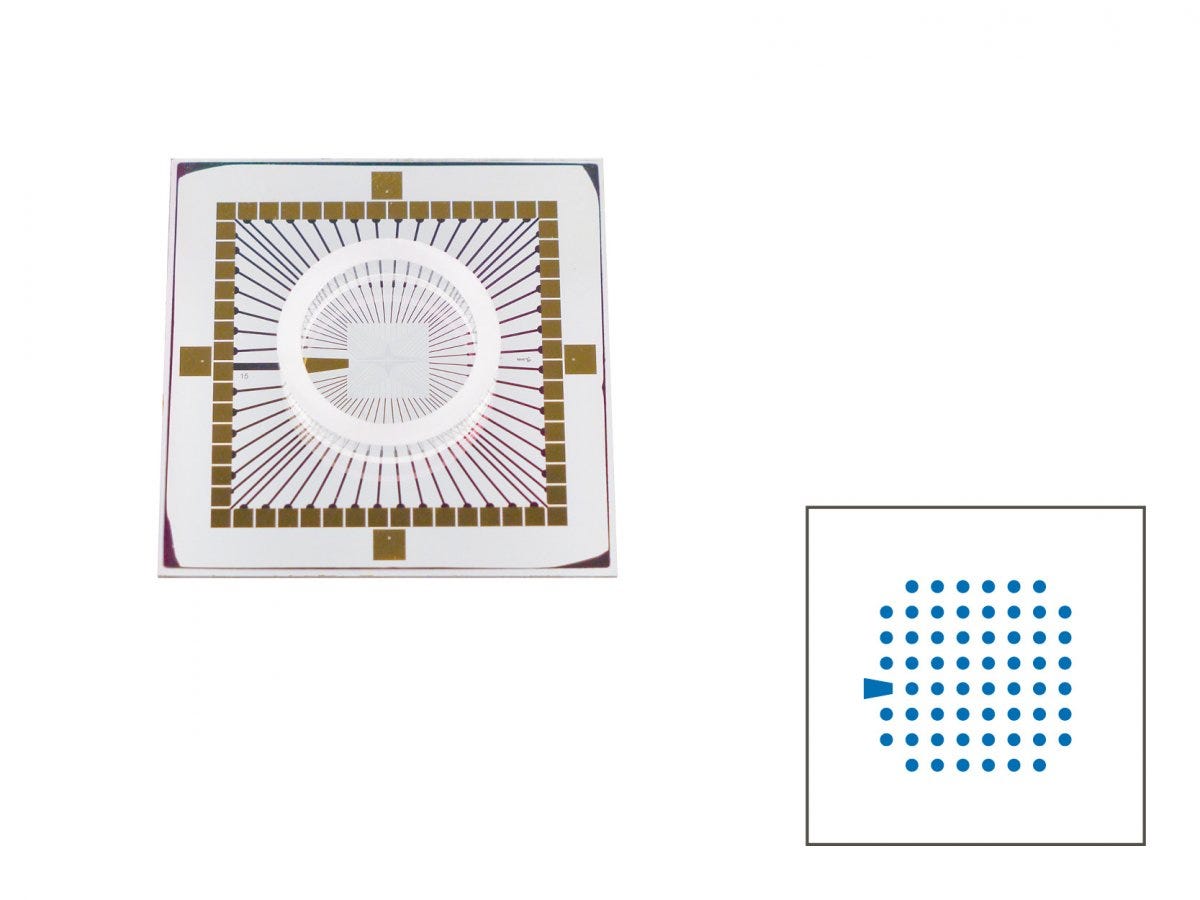 There is an underlying thermostat to maintain the temperature. One electrode is used as ground.
These researchers added a coating of polyornithine which creates a positively charged surface for subsequent attachments to stick. Note: cells and neurons are negatively charged on the inside with the -70 mV resting potential. But polyornithine alone is not enough, we also need biological cues for neuron connectivity. Thus we apply the BD matrigel on top 20 minutes before seeding the neurons.
100 μL of cell suspension is placed onto the MEA’s electrode area with approximately 80 000 cells/cm^2. Researchers let them sit for 20 minutes at room temperature. Then, we add 1 mL of culture medium to the MEA. Cultures are maintained in the incubator set to 37°C, 5% CO, and 95% humidity. Neuronal cultures older than 25 days usually exhibit robust and reproducible responses.